11 Lead/Silver smelting

11.1 Learning objective
In this unit you will learn about different processes that allow to extract lead and silver from their ores and to subsequently separate the two metals from each other.
11.2 Prior knowledge
11.3 Outline
The unit combines text with a photo gallery.
11.4 Learning content
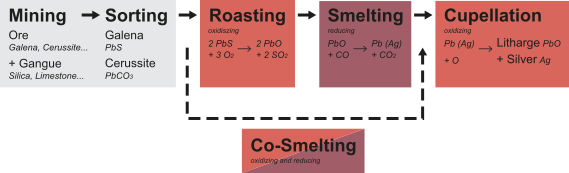
Ancient lead and silver metallurgy are inseparable from each other. This is due to the fact that lead and silver commonly occur together in the same mineralisation types and that silver can only be won from more complex ores by collecting it with lead, from which it is subsequently separated (#fig-flowchart).
Abbildung Flowchart Cupellation
- Baron, S., Le-Carlier, C., Carignan, J., and Ploquin, A., 2009, Archaeological reconstruction of me-dieval lead production: Implications for ancient metal provenance studies and paleopollution tracing by Pb isotopes, Applied Geochemistry, 24(11), 2093–101. 10.1016/j.apgeochem.2009.08.003
11.4.1 Ores
Although a wide variety of lead-bearing phases exist, only galena occurs in large-scale deposits (commonly associated with iron and zinc sulphides) and hence is the principal source of lead. Cerussite and anglesite as secondary minerals can be enriched in the uppermost weathered parts of the ore bodies. Cerussite and anglesite are poor hosts for silver (Keim et al. 2016). Galena principally also is the most important silver ore, which either is hosted in solid solution or occurs as micro-scale inclusions of discrete minerals such as pyrargyrite, proustite and stephanite. Notable amounts of silver can be incorporated in the galena lattice by coupled substitution due to solid solution in the Pb2S2–AgSbS2, Pb2S2–AgBiS2 and Pb2S2–AgAsS2 mixing series (Chutas et al. 2008; Renock and Becker 2011). Other locally relevant silver carriers are sulphosalt minerals, particularly of the tetrahedrite group, tellurides as well as silver-bearing jarosite Table 11.1. The latter is known to have been mined on a large scale in the Rio Tinto region in southwest Spain (e.g. Anguilano et al. 2010).
| Mineral Group | Mineral | Chemical formula | Silver content | Note |
|---|---|---|---|---|
| Elements | Silver | Ag | 100.00% | Native gold |
| Sulphides and sulphosalts | Acanthite | Ag2S | 87.00% | |
| Sulphides and sulphosalts | Galena | PbS | Up to 9%, typically <1 wt% | Values taken from Foord et al. (1988) and George et al. (2015) |
| Sulphides and sulphosalts | Dyscrasite | Ag3Sb | 73.00% | |
| Sulphides and sulphosalts | Polybasite -pearceite series | [Ag9CuS4][(Ag,Cu)6(Sb,As)2S7]–[Ag9CuS4][(Ag,Cu)6(As,Sb)2S7] | ~55-70% | Different subtypes are distinguished based on the crystallographic structures (cf. Bindi et al. 2007) |
| Sulphides and sulphosalts | Proustite-pyrargyrite series | Ag3AsS3-Ag3SbS3 | 65-60% | |
| Sulphides and sulphosalts | Stephanite | Ag5SbS4 | 68.00% | |
| Sulphides and sulphosalts | Freibergite (tetrahedrite group) | Ag6(Cu4Fe2)Sb4S12 | The boundary between freibergite and Ag-rich tetrahedrite is unknown and further studies are required. | |
| Sulphides and sulphosalts | Argentotennantite (tetrahedrite group) Note 1 1 | Ag6(Cu4Zn2)As4S13 | ||
| Sulphides and sulphosalts | Argentotetrahedrite (tetrahedrite group) | Ag6Cu4(Fe,Zn)2Sb4S13 | ||
| Sulphides and sulphosalts | Hessite | Ag2Te | 63.00% | |
| Sulphides and sulphosalts | Petzite | Ag3AuTe2 | 42.00% | |
| Sulphides and sulphosalts | Sylvanite | AgAuTe4 | ||
| Halides Note 2 2 | Chlorargyrite/cerargyrite | AgCl | 75.00% | |
| Halides | Bromargyrite | AgBr | 57.00% | |
| Carbonates | Cerussite | PbCO3 | 0.08 ppm on average | Value taken from Keim et al. (2016) |
| Sulphates | Argentojarosite | AgFe(SO4)2(OH)6 | 19.00% | |
| Sulphates | Anglesite | PbSO4 | Below the detection limit | Value taken from Keim et al. (2016) |
11.4.2 Pyrometallurgical practice
Lead extraction from galena or e.g. cerussite and anglesite as its weathering products was carried out by reductive smelting. The extraction of silver from ores other than native silver and halides required a multi-stage process, with further steps subsequent to initial reductive smelting.
11.4.2.1 Reduction smelting
Sulphide ore first has to be subjected to an oxidative environment to drive off sulphur and convert it into oxidic phases. This can take place either as a separate roasting procedure prior to reductive smelting or as an in-situ reaction in the upper parts of the smelting furnace, whereas reduction mostly takes place in the lower levels of the installation. In case of non-sulphide ores such as cerussite or anglesite for lead production and halides as silver sources, (pre-)roasting is not necessary, since these ores can be directly reduced to metal in a crucible or furnace. If sulphide ores were used to win silver, silver is collected during reductive smelting by liquid lead metal, generating argentiferous crude lead as the product of this process step. Due to its high density and immiscibility with slag, the liquid lead segregates to the bottom of the furnace. Extraneous lead (as scrap from lead metal or lead oxide) had to be added to the smelting batch if the charged ores did not contain sufficient lead (“leaded smelting”). This was the case if the furnace charge was not dominated by e.g. galena as lead carrier but contained a high proportion of e.g. polymetallic ores with elevated arsenic and antimony contents or silver-bearing copper ores. Products of such furnace charges possibly are matte and speiss (see chap. 10) besides lead metal and slag. Due to their different densities and non-existent miscibility of the different liquids, they separate well into specific layers.
11.4.2.2 Cupellation: Separating silver from lead
In the previous reduction smelting step, the lead metal collected the precious metals, i.e. silver, but potentially also gold and platinum-group elements, and isolated them from slag and, if present, the base metal melts matte and speiss. In the subsequent cupellation step, silver is separated from lead. This process takes advantage of the less noble character of lead, which hence is more readily oxidised to lead oxide while silver remains in metallic state. The oxygen partial pressure in the system determines the solubility of silver in lead oxide and thus how much Ag is lost to the lead oxide. The process must therefore be optimally adjusted. Other base metals such as copper, antimony and tin possibly present as inclusions of matte and speiss in the argentiferous crude lead are efficiently oxidised as well, yielding highly purified silver.
The simplest form of cupellation is to place argentiferous crude lead is a furnace and allow it to melt slowly in a charcoal fire. The oxidised liquid lead sinks into the ash while the silver emerges in the middle. This is called silver melted out in the ashes (haibukigin). Typically, cupellation was carried out either in bowl-shaped hearths or by using cupels, a specific type of refractory ceramic vessel. In both methods, the liquid lead metal is transformed by a constant airflow to lead oxide, whose density is significantly lower than that of metallic lead. To test a small amount of lead bullion for its precious metal content, cupel crucibles were also used.
Cupels are unambiguous indicators of pyrometallurgical precious metal processing. They are, however, rarely found at the metallurgical sites because lead oxide typically was either recycled, i.e. by pyrometallurgical reduction to de-silvered lead metal or by addition to reduction smelting charges, or used as a product in its own right, e.g. for medicine (Rehren et al. 1999).
11.4.2.2.1 Cupels
Cupels are highly absorbent and porous refractory vessels with a shallow concave depression. They were made of bone or plant ash and had a low silica content (Eckstein et al. 1994; Rehren and Klappauf 1995; Martinón-Torres et al. 2008) to avoid slagging of lead oxide and thus the formation of a glaze-like component sealing off the surface. Lead oxide produced by oxidation of the liquid lead metal in air flow is absorbed by the cupels, which become significantly heavier. The process is continued until only a drop of precious metal (regulus), initially covered by a thin black skin of lead oxide, remains on top of the cupel. The moment in which the skin tears open to reveal the metallic silver is called „silver look“ (German: „Silberblick“ or “Güldisch Silber”). It was a decisive marker for the ancient metallurgists as any further oxidation would have led to the formation of silver oxide phases and therefore silver losses to the cupel. Used cupels may show a typical coloration, e.g. green from soaked-up copper compounds.
11.4.2.2.2 Bowl-shaped hearths
The liquid lead metal in the hearth depression is surficially oxidised to lead oxide by blowing air over the surface of the molten mass, which floats on top (Rehren et al. 1999). The lead oxide can either be tapped into a receptacle (Krause et al. 2023) or skimmed off, generating characteristic litharge rods found at e.g. several sites of the Iberian Peninsula (Domergue 1990) and in the district of Lavrion, Greece (Conophagos 1980). After all the lead oxide is removed from the hearth, only native silver is left over.
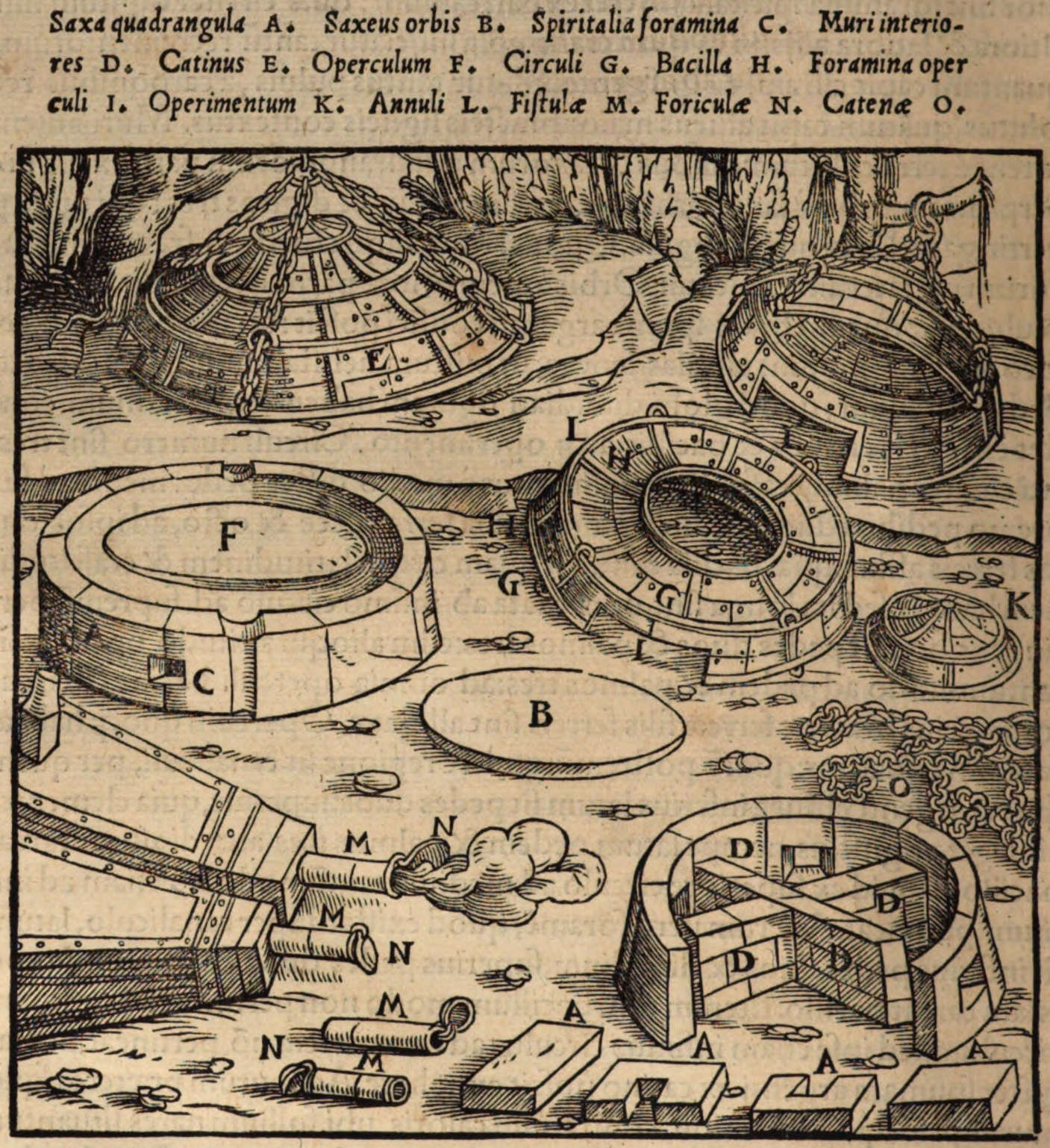
- Abbildung Agricola: Schmelz- und Kupellationsöfen
- Agricola, G., 1561, De re metallica Libri XII Basileae : Frobenius et Episcopius ed. Münchener Digitalisierungzentrum, Bayerische Staatsbibliothek München
- Creative Commons Licence CC0 1.0 Universe
11.4.2.3 Saiger process: Extraction of silver from silver-rich copper
Besides the silver production from lead ore, silver can also be gained from silver-rich copper sulphide ores. In the pyrometallurgical smelting process of the copper ore, the silver passed on into the copper metal (black copper = silver-rich copper). The extraction of silver from the black copper is a subsequent procedure known as the liquation and drying process, the saiger process (germ. also known as Saigerhüttenprozess). This process was intensively employed in Medieval Europe (L’Héritier and Téreygeol 2010) from the 16th century at the latest. It is also recorded in the illustrated japanese treatise Kodō Zuroku on the smelting of copper from 1801 (Hauptmann 1984).
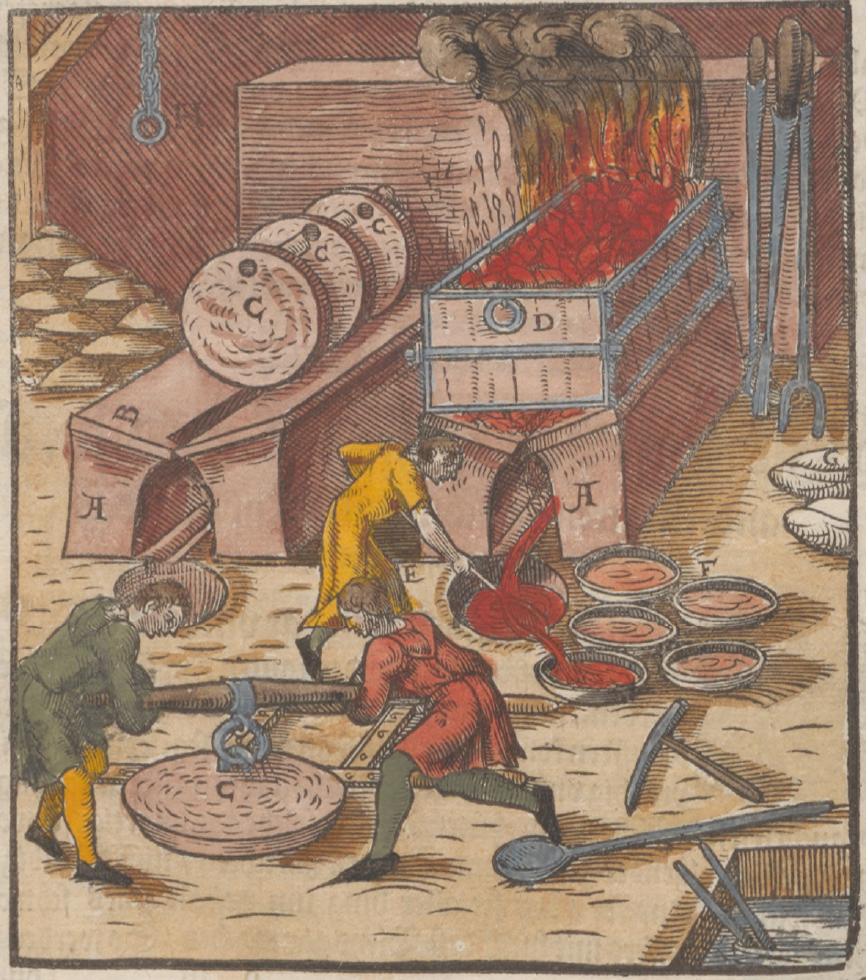
The first step is the casting of liquation cakes (germ.: das Frischen). The silver-rich black copper and added lead metal (and/or lead oxide) are melted together. Several differences in the physical properties of metallic copper and lead are conducive to a successful process. Copper and lead are almost completely immiscible in both liquid and solid state, the metals have highly different densities, and the melting point of lead is significantly lower than that of copper. Therefore, the produced melt has to be stirred thoroughly, e.g. by using an iron stick. Otherwise, copper and lead would instantly separate from each other. The melt then is quickly poured into a mould for solidification. At this state, the silver already passed from the copper into the lead. Microscopically, copper and lead, the latter acting as a collector for the silver, form distinct phases in the cakes.
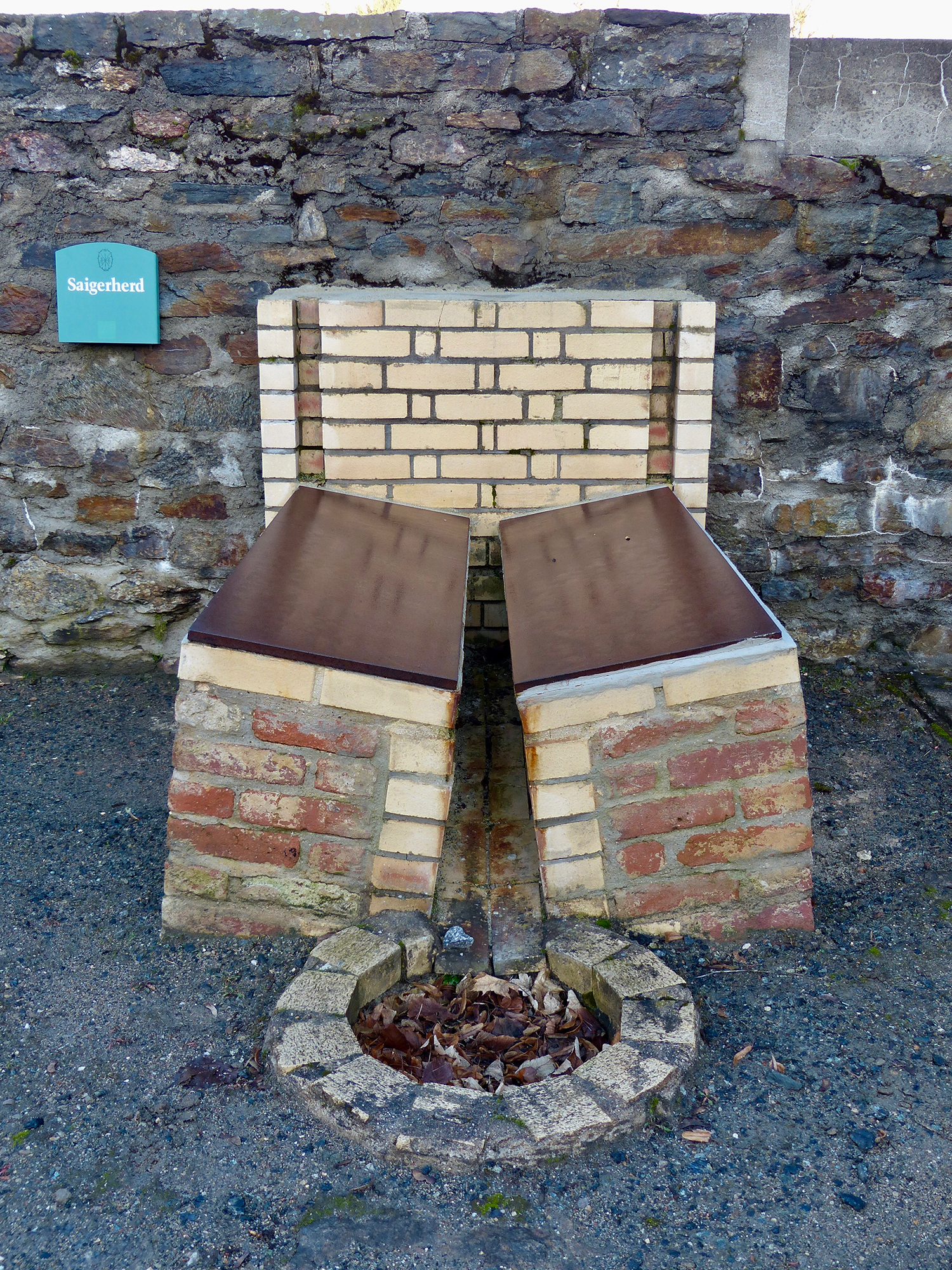
The second step in this procedure is the liquation process. In a specifically designed installation, the liquation hearth is a cake trough (Figure 11.3), e.g. sloped copper plates, on which the cakes are stacked in upright position. The furnace is built around them (Figure 11.4). Temperatures needed are between the melting point of lead and the copper to partially melt the lead but not the copper. Underneath the trough is a sloped channel and a receiving pit at its very end. This allows the silver-containing lead melt to run off into the pit leaving the de-silvered copper cakes (= exhausted or dried cakes) behind (Figure 11.5). What remains is a solid framework of copper (germ.: Seigerdörner). In Japanese context, the copper from this process is known as shiboridō (squeezed copper), while the lead is called leaked lead . The Saiger process can be progressively repeated to completely de-silver the copper cakes and to gain as much silver as possible from the copper. After the lead is collected and has cooled down, the solidified puddles (lead bullions) with the collected silver can be further processed. Separating the silver from the lead is done by the cupellation process (L’Héritier and Téreygeol 2010).

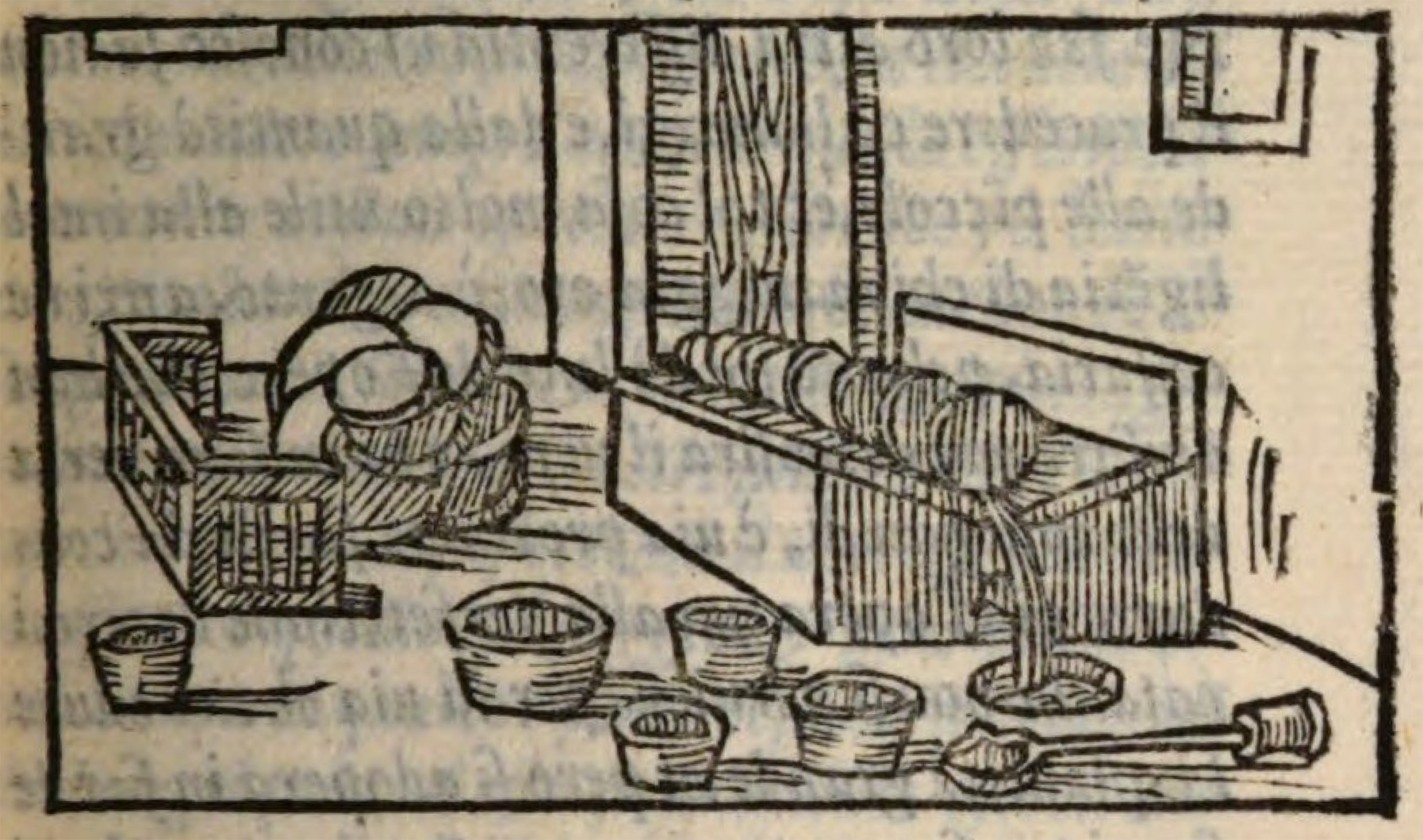
11.4.2.4 “Reißscheiben”/“Scheibenreißen”: Refining of exhausted copper cakes
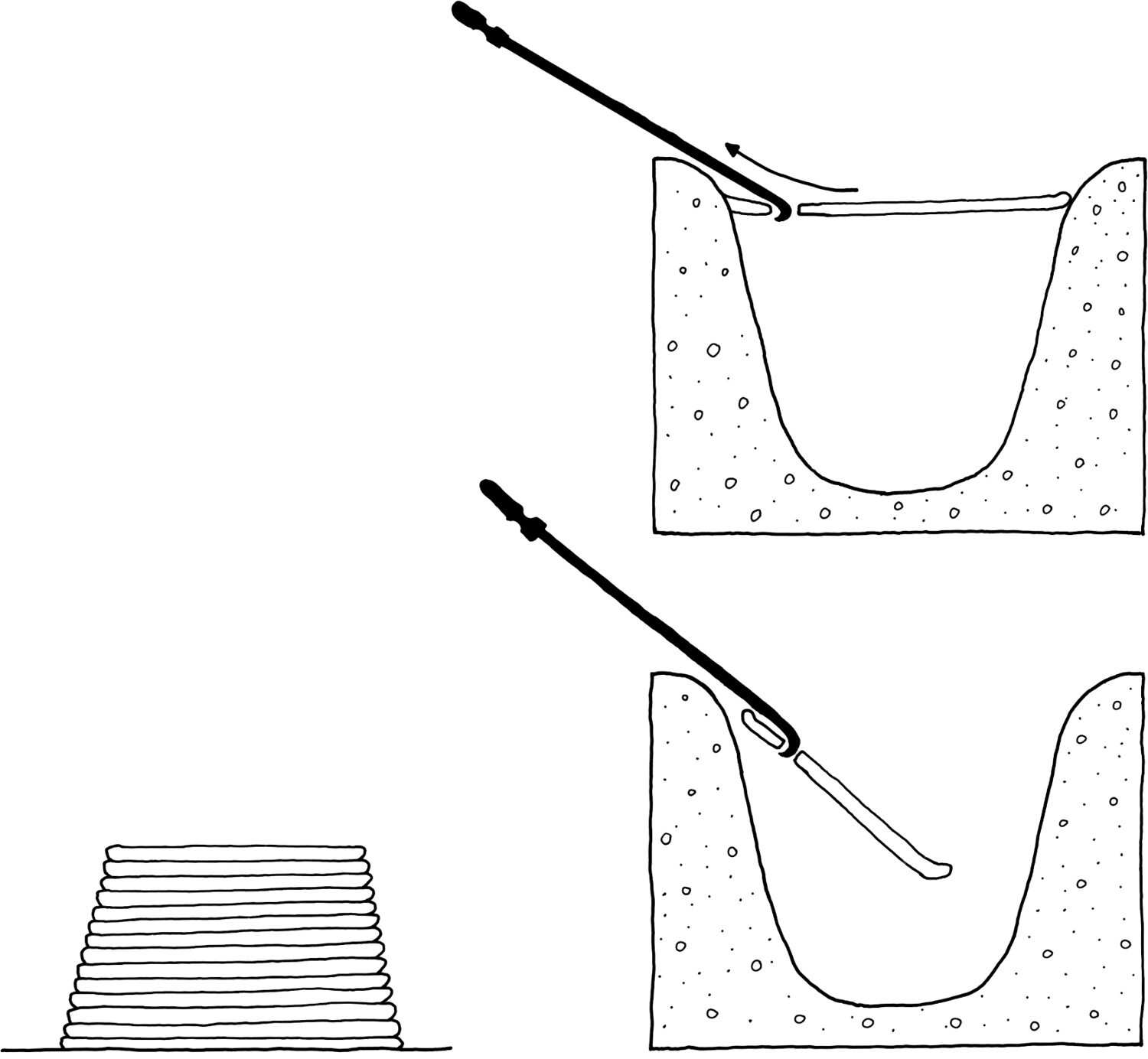
The exhausted (dry) copper cakes can still contain some lead, traces of collected silver and other impurities. To refine the copper metal from this process, the dry copper cakes are remelted in a trough. After completely molten, the surface is sprinkled with water, forcing the copper to solidify on the surface. Floating on the molten metal, thin, disc-shaped (round, oval or sub-triangular) discs are formed. By repeatedly stripping the solidified copper discs from the same trough, a series of Reißscheiben with constantly decreasing diameters are produced (Figure 11.6). Archaeological findings have shown that they are sometimes only a few tens of millimeters thick. These were found in large numbers in medieval archaeological context (Werson 2015) of this time and are described in detail in medieval texts of the 16th century CE written by Agricola et al. (1950), Biringuccio (1990) and Ercker (1580). More details and references herein can be found in Martinón-Torres et al. (2018).
11.4.3 Gallery
Click on an image to enlarge it. Press o to display an overview of all images.
11.5 Self check
Now you can provide answers to the following questions:
- How are the metals lead and silver related in pre-modern metallurgy?
- For what purposes were lead and silver used in pre-modern time?
- What are typical ore minerals of lead and/or silver?
- Which different processes were applied to extract silver from Pb- and Cu-rich ores?
11.6 Further reading
- Rehren T (1996) Alchemy and Fire Assay - An Analytical Approach. Historical Metallurgy 30:136–142. (read online)
- Baron S, Le-Carlier C, Carignan J, Ploquin A (2009) Archaeological reconstruction of medieval lead production: Implications for ancient metal provenance studies and paleopollution tracing by Pb isotopes. Applied Geochemistry 24:2093–2101. https://doi.org/10.1016/j.apgeochem.2009.08.003 (read online)
- Nriagu JO (1985) Cupellation: The oldest quantitative chemical process. J. Chem. Educ. 62:668. https://doi.org/10.1021/ed062p668
- Swinbourne DR, Yan S, Hoang G, Higgins D (2013) Thermodynamic modelling of cupellation: Activity of AgO 0·5 in molten PbO at 1000ºC. Mineral Processing and Extractive Metallurgy 112:69–74. https://doi.org/10.1179/037195503225002754
- Merkel SW (2021) Evidence for the widespread use of dry silver ore in the Early Islamic period and its implications for the history of silver metallurgy. J. Archaeol. Sci. 135:105478. https://doi.org/10.1016/j.jas.2021.105478
Tetrahedrite group: Only minerals officially recognised by the IMA listed (cf. Biagioni et al. 2020 for further information).↩︎
Halides and native Ag as well as more rarely sulphosalt compounds are also termed “dry ores” for their lack of lead.↩︎